
La Bohème, Giacomo Puccini’s masterpiece of youthful love and loss, adapts Henri Murger’s Scènes de la vie de bohème, portraying the bittersweet lives of struggling artists in 1830s Paris. At its heart is the romance between poet Rodolfo and seamstress Mimì, whose delicate love is shadowed by poverty and illness. Puccini’s music, tender and emotionally direct, has made La Bohème one of the most enduring and beloved operas in the world.
- The Origins of Bohème
- Bohème: a Bouquet of Melodic Invention
- Bohème for Chamber Orchestra (18-28 players)
- Bohème for Chamber Ensemble (13-15 players)
- Bohème for Smaller Ensemble (7-9 players)
- Order Score & Parts of Boheme (Puccini)
The Origins of Bohème
Puccini discovered Henri Murger’s Scènes de la vie de bohème in the early 1890s and was immediately drawn to its mix of humor, romance, and tragedy. He wrote: “I wept and laughed while reading it—this is my opera.” At the time, he was living in Torre del Lago, where much of the composition took place. Librettists Luigi Illica and Giuseppe Giacosa worked closely with Puccini, often under tension; he demanded naturalistic dialogue and emotional authenticity. He famously told Illica: “More feeling, less fuss!”
A rivalry with composer Ruggero Leoncavallo, who was working on his own Bohème, added urgency to Puccini’s efforts. “Let him compose, I will too,” Puccini said. Despite heated exchanges in the press, it was Puccini’s version that captured the public’s heart. Puccini focused on intimate musical textures and atmospheric detail. The arias, especially “Che gelida manina” and “Mi chiamano Mimì,” were crafted with loving precision. Though immersed in nostalgia for Parisian life, Puccini grounded the story in human experience. His friend and conductor Toscanini later recalled: “He painted the cold, the laughter, the love—all with music that feels like breathing.” The opera was finished in late 1895 and quickly prepared for its premiere in Turin.
Bohème: a Bouquet of Melodic Invention
La Bohème premiered on February 1, 1896, at the Teatro Regio in Turin, conducted by a young Arturo Toscanini. Initial reviews were mixed. Some critics found it too sentimental, and a few compared it unfavorably to the more dramatic works of Wagner or the realism of Mascagni. However, the audience responded with enthusiasm. Toscanini remembered: “It was clear even then that this opera would live.” One critic wrote in La Stampa: “The score glows with melodic invention and genuine feeling.” Still, some critics called it “a bouquet of songs” rather than a unified work.
Puccini was undeterred. The opera quickly gained popularity in Rome, Palermo, and Naples. By 1898 it had reached London, and in 1900 the Metropolitan Opera in New York. Audiences were especially moved by Mimì’s death in Act IV; many wept openly. The realism, humor, and humanity of the work helped establish a new standard for verismo opera—though Puccini’s emotional subtlety transcended the label. Over the next century, La Bohème became a cornerstone of the operatic repertory, admired by composers from Stravinsky to Bernstein. Toscanini later recorded it in 1946 with the NBC Symphony Orchestra—the only Puccini opera he ever recorded—testifying to its lasting impact.
Bohème for Chamber Orchestra (18-28 players)
La Bohème is scored for a large Romantic orchestra: full strings, woodwinds in pairs (with added piccolo and bass clarinet), four horns, three trumpets, three trombones, timpani, percussion, harp, and offstage band. The total orchestra may number 60–70 musicians. Although the lush scoring adds depth and atmosphere, La Bohème can be effectively adapted for chamber orchestras. Reduced versions (25–35 players) are frequently used in smaller theaters, preserving the opera’s emotional intimacy while enhancing its flexibility for modern productions. Bohème for Chamber Orchestra is under preparation and will require:
- Flute with piccolo, oboe, clarinet, bassoon
- (French) Horn, trumpet
- Optional trombone
- 1-2 percussionists: timpani, triangle, snare & bass drum, cymbals
- A keyboard for glockenspiel, harp, xylophone
- String orchestra (10-18 players):
- 3-6 first violins
- 3-6 second violins
- 2-3 violas
- 1-2 cellos
- 1 bass
Bohème for Chamber Ensemble (13-15 players)
With only one player per string part, careful attention must be given to sound balance. Unlike the Chamber Orchestra version, which includes a fuller string section, the reduced string forces can be easily overpowered by winds or percussion. We recommend subtle amplification of the strings where possible, or alternatively, strategic dynamic adjustments—such as reducing wind and percussion volume—to maintain clarity and ensemble blend. Bohème for Chamber Ensemble is under preparation and will require:
- Flute with piccolo, oboe, clarinet, bassoon
- (French) Horn, trumpet
- Optional trombone
- 1-2 percussionists: timpani, triangle, snare & bass drum, cymbals, low bell
- A keyboard for glockenspiel, harp, xylophone
- String quintet (1.1.1.1.1)
Open12 Edition
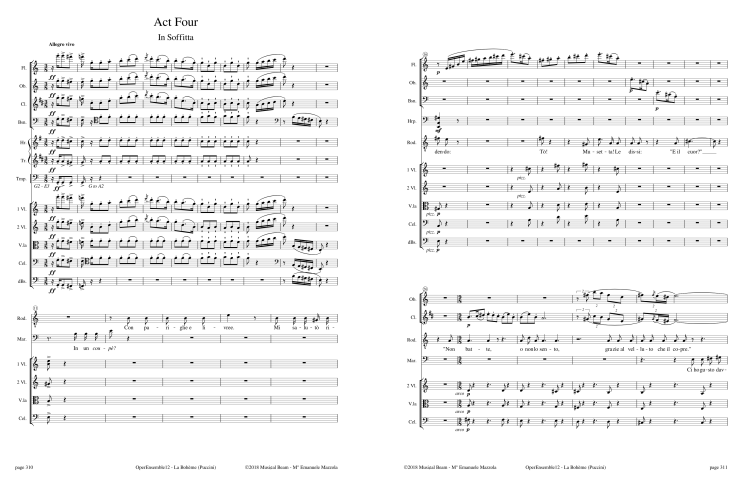
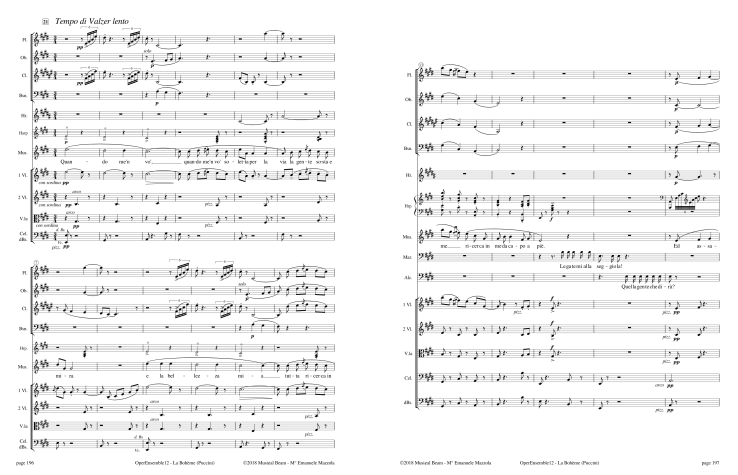
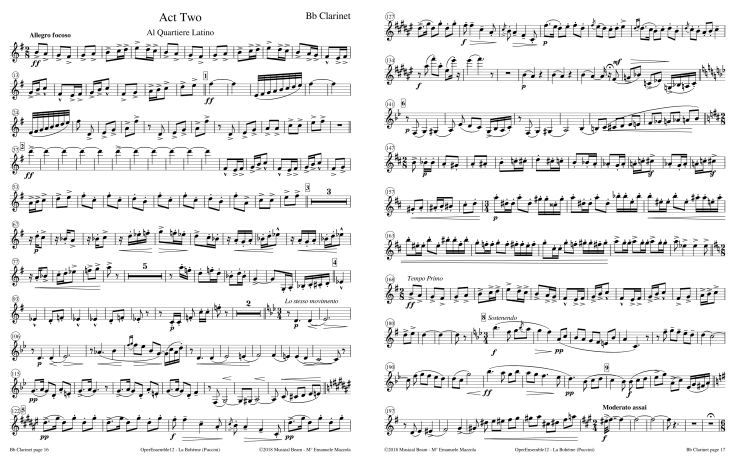
Open12 Editions are similar to the newer Chamber Ensemble versions.. The upgrade includes more options and higher printing standards, including cues in multi-rests and larger fonts. The Open12 Edition of Bohème will remain available until the Chamber Ensemble version is issued.






Bohème for Smaller Ensemble (7-9 players)
The Smaller Ensemble version is designed for maximum reduction without compromising musical integrity. It features a string quartet, three woodwinds, and piano. The piano part is not a vocal score, but a fully notated performance part, often playable with one hand, intended for the conductor or a designated player. It reinforces the ensemble in forte and fortissimo sections, ensuring depth and rhythmic clarity. With its balanced orchestration across winds, strings, and keyboard percussion, this version requires no special adjustments and offers a complete and practical solution for venues with limited resources or space. Bohème for Smaller Ensemble is under preparation and will require:
- Flute, oboe, clarinet
- String quartet with optional bass
- Piano or keyboard (conductor)


 Musical Beam