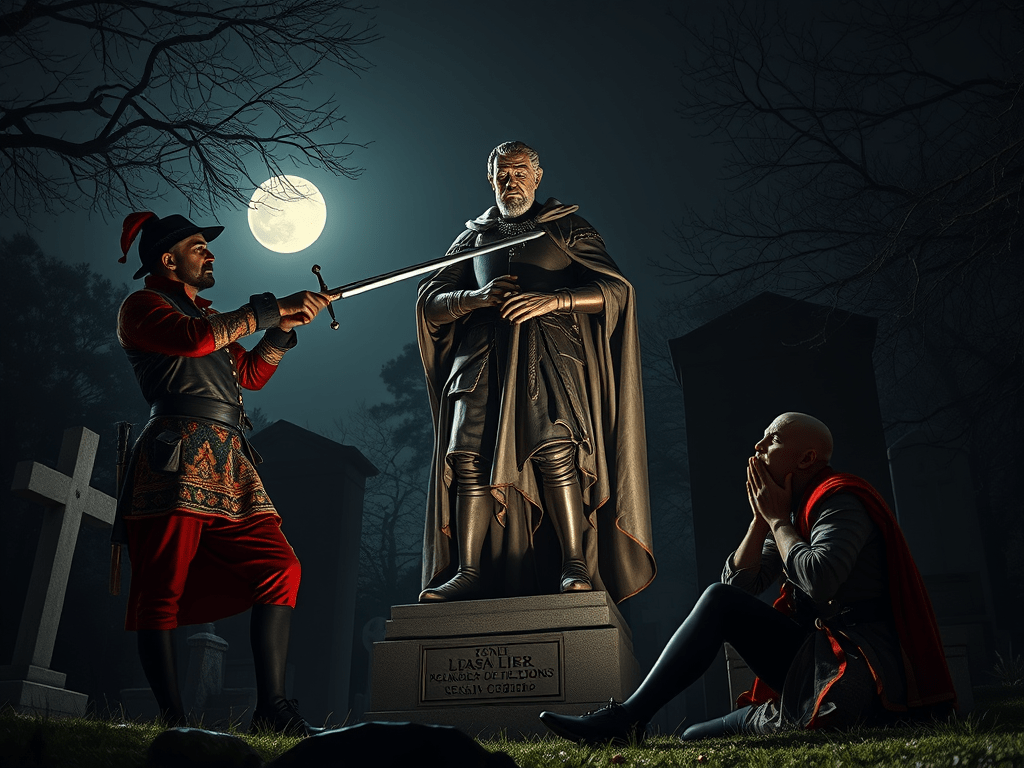
Commissioned after the immense success of The Marriage of Figaro, Don Giovanni tells the tale of a libertine, blending comedy, tragedy, and the supernatural. Mozart composed it during a period of personal and professional triumph, yet also growing financial strain. His intention was to create a “dramma giocoso,” a genre merging humor and moral reckoning, rendered with unmatched dramatic and musical sophistication.
- The Origins of Don Giovanni
- Mozart’s Don Giovanni: Laughter and Terror
- Don Giovanni for Chamber Orchestra (17-27 players)
- Don Giovanni for Chamber Ensemble (12-14 players)
- Don Giovanni for Smaller Ensemble (7-9 players)
- Order score and parts of Don Giovanni (Mozart)
The Origins of Don Giovanni
Mozart began composing Don Giovanni in early 1787, soon after his triumphant visit to Prague, where Le nozze di Figaro had been wildly successful. Prague’s musical public adored his work, prompting a commission from the impresario Pasquale Bondini for a new opera. Mozart, writing to his friend Gottfried von Jacquin, remarked that “here they understand me and I understand them.” The libretto, crafted by Lorenzo Da Ponte, drew on the Don Juan legend as popularized by Tirso de Molina and Molière.
Composition took place partly in Vienna and mostly in Prague, where Mozart worked feverishly in the autumn of 1787, even finalizing the overture the night before the premiere. According to Da Ponte, Mozart composed the overture “with a glass of punch in his hand,” dictating parts while laughing with his friends. Prague’s musical environment was fertile: orchestras were excellent, and a lively aristocratic culture encouraged innovation.
Mozart’s Don Giovanni: Laughter and Terror
The Prague premiere of Don Giovanni on October 29, 1787, was an overwhelming success. Eyewitness accounts describe thunderous applause and repeated encores. The Prager Oberpostamt-Zeitung hailed it as “a masterpiece of the highest quality,” praising Mozart’s “sublime understanding of harmony and character.” Prague’s audiences embraced the opera’s bold fusion of comic and tragic tones. When the opera reached Vienna in May 1788, however, reactions were more restrained. Viennese critics admired the music’s sophistication but found the work “too learned” and emotionally unsettling.
Emperor Joseph II is said to have remarked that the piece was “divine, but not for our Viennese,” reflecting a certain ambivalence. Da Ponte later recalled that Viennese society was “bewildered by its mixture of laughter and terror.” Over time, however, Don Giovanni became recognized as one of the supreme achievements of Western art. Beethoven reportedly declared that “Mozart’s Don Giovanni will be my model,” while Kierkegaard called it “the perfect opera.” The blend of sensuality, morality, and metaphysical dread captured the spirit of the age—both Enlightenment skepticism and romantic yearning.
Don Giovanni for Chamber Orchestra (17-27 players)
The original Prague orchestra comprised about 35–40 musicians: pairs of flutes, oboes, clarinets, bassoons, horns, trumpets, timpani, and strings. Mozart tailored the roles to the vocal strengths of Prague’s leading performers, notably Luigi Bassi as Don Giovanni and Josefa Dušek’s circle of musicians. Today, while historically informed performances often use the original orchestra setting, Don Giovanni’s intricate textures can still be compellingly realized with chamber forces, offering intimacy and dramatic immediacy without diminishing its expressive power. Don Giovanni for Chamber Orchestra is under preparation and will require:
- Flute, oboe, clarinet, bassoon
- (French) Horn, trumpet
- Timpani
- Optional mandolin
- String orchestra (10-18 players):
- 3-6 first violins
- 3-6 second violins
- 2-3 violas
- 1-2 cellos
- Bass
- Continuo (conductor)
Don Giovanni for Chamber Ensemble (12-14 players)
With only one player per string part, careful attention must be given to sound balance. Unlike the Chamber Orchestra version, which includes a fuller string section, the reduced string forces can be easily overpowered by winds or percussion. We recommend subtle amplification of the strings where possible, or alternatively, strategic dynamic adjustments—such as reducing wind and percussion volume—to maintain clarity and ensemble blend. Don Giovanni for Chamber Ensemble requires:
- Flute, oboe, clarinet, bassoon
- (French) Horn, trumpet
- Timpani
- Optional mandolin
- String quintet (1.1.1.1.1)
- Continuo (conductor)
Don Giovanni for Smaller Ensemble (7-9 players)
The Smaller Ensemble version is designed for maximum reduction without compromising musical integrity. It features a string quartet, three woodwinds, and piano. The piano part is not a vocal score, but a fully notated performance part, often playable with one hand, intended for the conductor or a designated player. It reinforces the ensemble in forte and fortissimo sections, ensuring depth and rhythmic clarity. With its balanced orchestration across winds, strings, and keyboard percussion, this version requires no special adjustments and offers a complete and practical solution for venues with limited resources or space. Don Giovanni for Smaller Ensemble is under preparation and will require:
- Flute, oboe, clarinet
- String quartet with optional bass
- Piano or keyboard (conductor)


 Musical Beam