
Opera Editions for Chamber Orchestra and Smaller Ensembles
After nearly two decades of experience in orchestration for smaller ensembles, I am pleased to present ChOsEn Opera Editions: a new publishing line designed to provide flexibility, clarity, and choice. Each opera is available in three orchestrations, all carefully revised with practical cues for players, balanced parts, and consistent layout.
Chamber Orchestra
17-26 players: flute/piccolo, oboe, clarinet, bassoon, horn, trumpet, 1–2 percussionists, optional/extra parts for trombone, harp, organ, chromatic percussions; 10-18 strings (3-6, 3-6, 2-3, 1-2, 1). This version offers the greatest flexibility, including additional parts for on- or off-stage ensembles, bands, or solo interjections. It provides a rich sound and an ideal balance between strings and winds, with most string parts preserved from the original score and page turns planned for practicality.
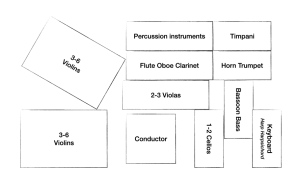
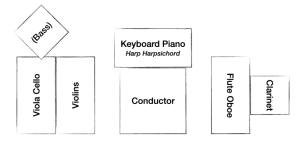
The orchestral layout in the image above suits Romantic operas (Verdi, Puccini). For Classical works (Mozart), you may wish to place the second violins on the conductor’s right (swapping positions with viola and cello) and to have the keyboard (harpsichord) either played by the conductor or positioned appropriately within the ensemble.
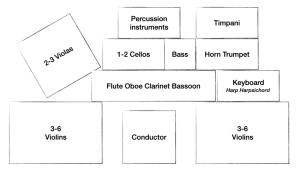
Chamber Ensemble
12–14 players: flute/piccolo, oboe, clarinet, bassoon, horn, trumpet, 1 or 2 percussionists, optional/extra parts for harp, organ, chromatic percussions; string quintet. This version reduces the Chamber Orchestra setup to one player per string part. It allows for shorter rehearsals and lower production costs while preserving the full color of the orchestration.
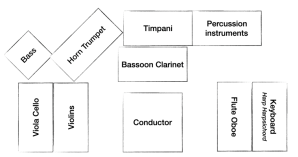
For balance, brass and percussion should be placed behind the strings and conductor, never facing the audience directly. If necessary, consider using muted percussion to blend better with the smaller group.
Small Ensemble
7–9 players: flute, oboe, clarinet, string quartet with optional bass, and piano (a newly arranged part—not a vocal score—covering percussive, bass, and brass lines). This is the most compact orchestration possible while still avoiding a reduction to vocal score. It maintains two independent sound groups: strings and woodwinds. The wind parts differ from larger versions, while the string parts remain identical to those in the Chamber Ensemble version. The piano part is designed to be mostly playable with one hand, leaving the conductor free to direct with the other.
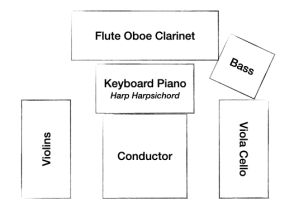
This version offers an effective balance between strings and winds, drastically reduces costs and required space, and minimizes rehearsal time—perfect for small theaters, touring productions, and educational projects. The image above shows two possible layouts.
 Musical Beam