Il Trovatore is one of Giuseppe Verdi’s most dramatic and musically powerful operas. Based on Antonio García Gutiérrez’s Spanish play El Trovador, the opera unfolds a turbulent story of love, vengeance, and fate across war-torn Spain. Its plot—rich in melodrama—features gypsies, mistaken identities, and tragic revelations. Verdi’s music is intensely rhythmic and emotionally charged, marked by famous arias like “Stride la vampa” and “Di quella pira.” Despite its convoluted story, Il Trovatore captivated audiences and remains a staple of the operatic canon.
- The Origins of Trovatore
- Trovatore: a Volcanic Drama
- Trovatore for Chamber Orchestra (18-28 players)
- Trovatore for Chamber Ensemble (13-15 players)
- Trovatore for Smaller Ensemble (7-9 players)
- Order Score & Parts of Trovatore (Verdi)
The Origins of Trovatore
Verdi began composing Il Trovatore in 1852 while simultaneously working on La Traviata. He chose Gutiérrez’s play for its passionate themes and theatrical action, saying: “The subject is beautiful, full of force and originality.” His longtime collaborator Salvadore Cammarano began the libretto, but tragically died before its completion. Verdi was shaken—he admired Cammarano’s restraint and structure. Much of the opera was composed in Busseto and Paris, and Verdi’s correspondence from this period reveals his deep engagement with character and orchestration. He wrote: “Each role must burn with passion—the music must speak their inner fire.”
Verdi particularly focused on Azucena, the gypsy woman whose tortured past shapes the entire drama, writing: “She is the soul of the opera.” The backdrop to the creation was Italy’s political unrest. Verdi, a strong supporter of Italian unification, saw in Il Trovatore the tragic consequences of conflict and injustice. Despite personal grief and artistic challenges, he poured extraordinary energy into the score. The orchestration brims with martial rhythms and haunting melodies, echoing the opera’s themes of war, memory, and fatal destiny. Verdi completed the work in late 1852, eager for its Roman premiere.
Trovatore: a Volcanic Drama
Il Trovatore premiered in Rome at the Teatro Apollo on January 19, 1853, just weeks before La Traviata‘s debut. The response was overwhelmingly positive. Verdi wrote to a friend: “Success, immense success! From the first act to the last, nothing but cheers and applause.” The audience, thrilled by the music’s raw power and the opera’s melodramatic appeal, demanded multiple encores. Critics, too, were impressed by the opera’s visceral impact. One Roman reviewer wrote: “The drama is violent, the music is volcanic—Verdi’s genius is unrestrained.” One French critic wrote: “You may not understand it, but you feel every note in your blood.”
Within months, Il Trovatore spread across Europe: Milan, Paris, London, and eventually New York in 1855. Its arias and choruses, especially the “Anvil Chorus,” became instant hits, even outside the theater. The opera’s popularity endured well into the 20th century; Enrico Caruso, Maria Callas, and Jussi Björling all made signature interpretations of its roles. Despite changing tastes, Il Trovatore remained essential repertoire—proof of Verdi’s ability to touch audiences with unrelenting drama and unforgettable melody.
Trovatore for Chamber Orchestra (18-28 players)
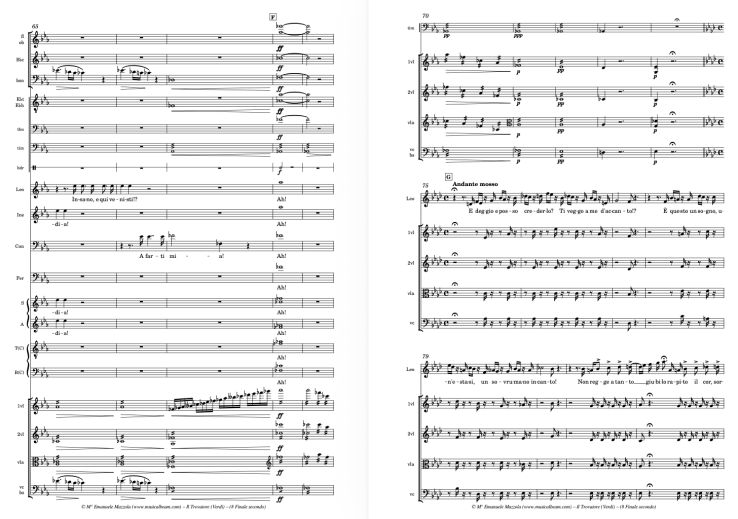
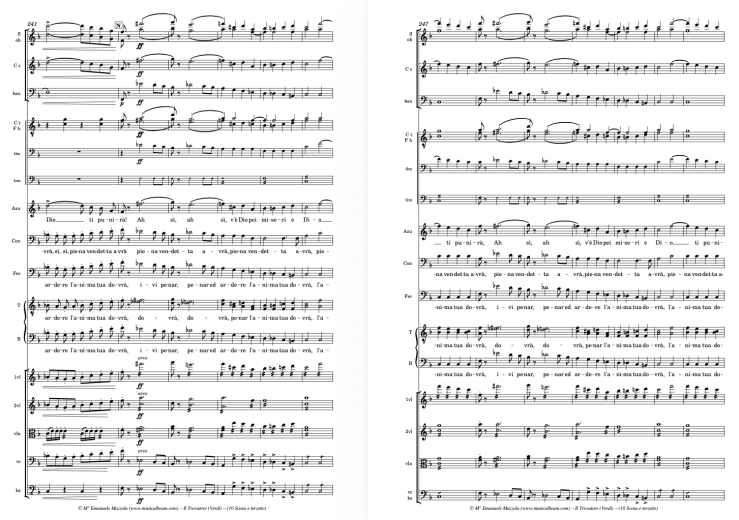
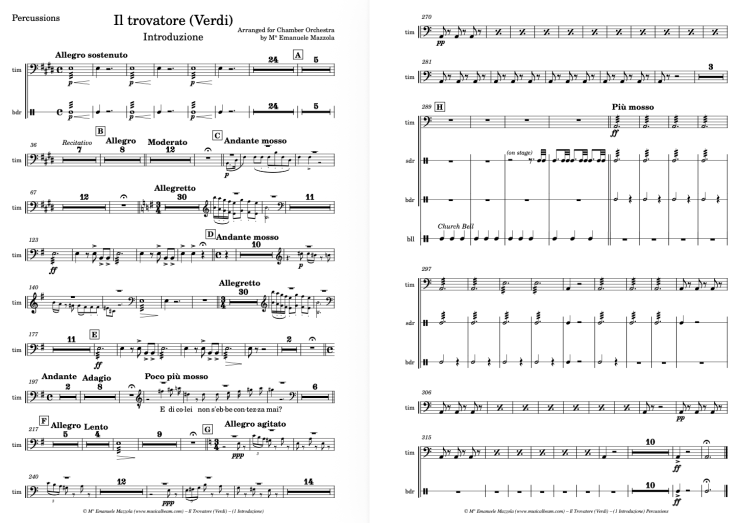
Verdi scored Il Trovatore for a standard Romantic orchestra: strings, pairs of woodwinds, four horns, two trumpets, three trombones, timpani, bass drum, and offstage banda, along with harp and chorus. The orchestration is powerful, but not unusually large, typically involving 50–60 musicians. Though richly scored, the opera’s robust vocal lines and clear textures allow for effective chamber adaptations. Smaller productions with 30–40 players have succeeded in conveying the opera’s dramatic tension without losing its impact. Trovatore for Chamber Orchestra requires:
- Flute with piccolo, oboe, clarinet, bassoon
- (French) Horn, trumpet
- Optional trombone
- 1 percussionist: timpani, triangle, snare & bass drum, hammers
- A keyboard for organ, harp (and bell)
- String orchestra (10-18 players):
- 3-6 first violins
- 3-6 second violins
- 2-3 violas
- 1-2 cellos
- 1 bass
- On/off stage, 1 optional percussionist: hammers, bell, snare drums





Trovatore for Chamber Ensemble (13-15 players)
With only one player per string part, careful attention must be given to sound balance. Unlike the Chamber Orchestra version, which includes a fuller string section, the reduced string forces can be easily overpowered by winds or percussion. We recommend subtle amplification of the strings where possible, or alternatively, strategic dynamic adjustments—such as reducing wind and percussion volume—to maintain clarity and ensemble blend. Bohème for Chamber Ensemble is under preparation and will require:
- Flute with piccolo, oboe, clarinet, bassoon
- (French) Horn, trumpet
- Optional trombone
- 1 percussionist: timpani, triangle, snare & bass drum, hammers
- A keyboard for organ, harp (and bell)
- String quintet (1.1.1.1.1)
- On/off stage, 1 optional percussionist: hammers, bell, snare drums
Open12 Edition
Open12 Editions are similar to the newer Chamber Ensemble versions.. The upgrade includes more options and higher printing standards, including cues in multi-rests and larger fonts. The Open12 Edition of Trovatore will remain available until the Chamber Ensemble version is published.


Trovatore for Smaller Ensemble (7-9 players)
The Smaller Ensemble version is designed for maximum reduction without compromising musical integrity. It features a string quartet, three woodwinds, and piano. The piano part is not a vocal score, but a fully notated performance part, often playable with one hand, intended for the conductor or a designated player. It reinforces the ensemble in forte and fortissimo sections, ensuring depth and rhythmic clarity. With its balanced orchestration across winds, strings, and keyboard percussion, this version requires no special adjustments and offers a complete and practical solution for venues with limited resources or space. Trovatore for Smaller Ensemble is under preparation and will require:
- Flute, oboe, clarinet
- String quartet with optional bass
- Piano or keyboard (conductor)
Open7 Editions
Open7 Editions are similar to the newer Smaller Ensemble versions.. The upgrade includes more options and higher printing standards, including cues in multi-rests and larger fonts. The Open7 Edition of Trovatore will remain available until the Smaller Ensemble version is published.


 Musical Beam