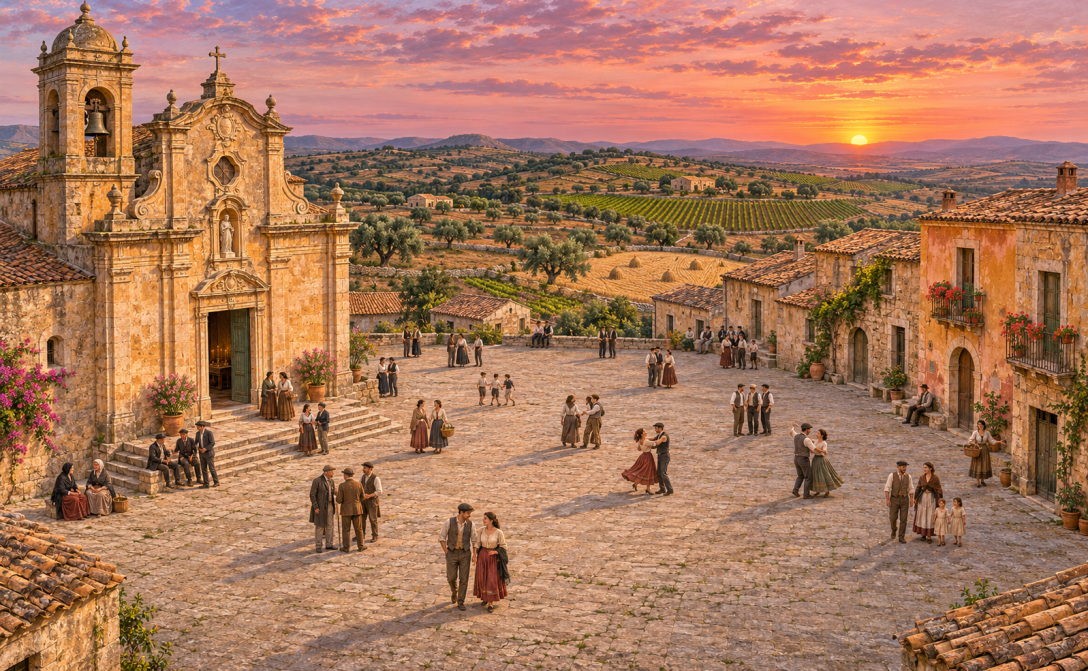
Ruggero Leoncavallo wrote both music and libretto for Pagliacci in 1891–1892. Set near Montalto in Calabria during the August religious festival, Pagliacci follows travelling actors whose staged comedy becomes a real murder. Canio discovers his wife Nedda’s infidelity and kills her and her lover, Silvio, before an initially unsuspecting audience. Inspired by the success of Mascagni’s Cavalleria rusticana, Leoncavallo combined memorable melody, dramatic orchestration and theatre within theatre to explore jealousy, public performance and private suffering through the language of verismo.
The Origins of Pagliacci
Pagliacci emerged from artistic frustration. In October 1891, Leoncavallo’s hopes for a Milan production of I Medici collapsed when Ricordi preferred other works, including Puccini’s revised Edgar. Mascagni’s sensational Cavalleria rusticana had demonstrated the possibilities of concentrated tragedy involving ordinary people. Part of the composition is associated with Vacallo, just across the Swiss border, where Puccini was also working on Manon Lescaut. Milan supplied the publishers, performers and theatrical negotiations that brought it to the stage.
Its Calabrian setting drew on childhood memories. In a letter to Sonzogno dated 3 September 1894, Leoncavallo described a murder at Montalto and his father’s involvement as magistrate. This was retrospective testimony: the documented 1865 killing concerned Gaetano Scavello, a family servant, rather than the opera’s double murder. Victor Maurel helped secure the production and, according to his later recollection, encouraged the Prologue. Leoncavallo’s text promises “uno squarcio di vita” (“a slice of life”). Rehearsals pleased Maurel and Toscanini, choristers studied eagerly, and the composer declared “alea iacta est” (“the die is cast”).
Pagliacci: Applause & Critical Doubts
The Milan premiere was an audience triumph, but critical approval was qualified. Alfredo Soffredini (Gazzetta musicale di Milano, 29 May 1892) acknowledged a “brilliant success” while questioning originality, particularly the bell chorus’s resemblance to Cavalleria rusticana. A June 1892 report in Le Ménestrel counted twenty-one calls for the composer. Yet the second performance never happened: unpaid orchestral musicians and choristers refused to work. Sonzogno intervened, taking over the theatre’s affairs and enabling six further performances. The newspaper described their reception as a tremendous success and reported that spectators remained applauding for ten minutes after the final performance.
These events reveal both popular enthusiasm and the insecure economics supporting Italian opera. Publicity was also carefully considered: before the premiere, Sonzogno warned Leoncavallo against organised applause, writing, “I have never wanted a claque.” Abroad, the work participated in arguments about verismo’s fascination with violence. Writing in Vienna’s Neue Freie Presse on 30 September 1892, Eduard Hanslick described its enormous dramatic tension while lamenting Italian opera’s retreat from comedy into jealousy and murder. Popular success therefore coexisted with aesthetic unease.
Pagliacci for Chamber Orchestra (19-27 players)
The score requires approximately 60–70 players. A chamber arrangement would reduce costs and pit requirements, facilitate touring, and bring intimate exchanges closer, while requiring sensitive redistribution of orchestral musical colour and preservation of the score’s dramatic climaxes. Pagliacci for Chamber Orchestra requires:
- Flute, oboe, clarinet, bassoon
- Horn, trumpet, optional trombone
- 1-2 percussionists (timpani, triangle, cymbals, bass drum, tam tam)
- Keyboard: glockenspiel, bells, harps
- String orchestra (10-18 players):
- 3-6 first violins
- 3-6 second violins
- 2-3 violas
- 1-2 cellos
- Bass
Pagliacci for Chamber Ensemble (13-15 players)
With only one player per string part, careful attention must be given to sound balance. Unlike the Chamber Orchestra version, which includes a fuller string section, the reduced string forces can be easily overpowered by winds or percussion. We recommend subtle amplification of the strings where possible, or alternatively, strategic dynamic adjustments—such as reducing wind and percussion volume—to maintain clarity and ensemble blend. Pagliacci for Chamber Ensemble is under preparation and will require:
- Flute, oboe, clarinet, bassoon
- Horn, trumpet, optional trombone
- 1-2 percussionists (timpani, triangle, side & bass drum, cymbals, tam tam)
- Keyboard: Glockenspiel, bells, harp
- String quintet (1.1.1.1.1)
Pagliacci for Small Ensemble (7-9 players)
The Smaller Ensemble version is designed for maximum reduction without compromising musical integrity. It features a string quartet, three woodwinds, and piano. The piano part is not a vocal score, but a fully notated performance part, often playable with one hand, intended for the conductor or a designated player. It reinforces the ensemble in forte and fortissimo sections, ensuring depth and rhythmic clarity. With its balanced orchestration across winds, strings, and keyboard percussion, this version requires no special adjustments and offers a complete and practical solution for venues with limited resources or space. Pagliacci for Small Ensemble is under preparation and will require:
- Flute, oboe, clarinet
- String quartet with optional bass
- Piano or keyboard (conductor)


